Farmer Benefit Plan & Trust
As developers, farm organizations, counties, state and federal policymakers search for practical approaches to aligning utility-scale clean energy projects with local interests, the need is not for one national mandate. The Farmer Benefit Plan & Trust (FBP&T) is a framework intended to provide a foundation that addresses this challenge. It combines flexibility with structure, and local priorities with scalable impact. It is a set of proven, adaptable tools that can work across many settings while maintaining local control and credibility.
A Framework, Not a Formula
The Farmer Benefit Plan & Trust is a flexible framework for ensuring that clean energy projects deliver meaningful, locally governed benefits to agricultural communities.
Potential benefits may include:
Farmland access through use of setbacks on renewable energy projects.
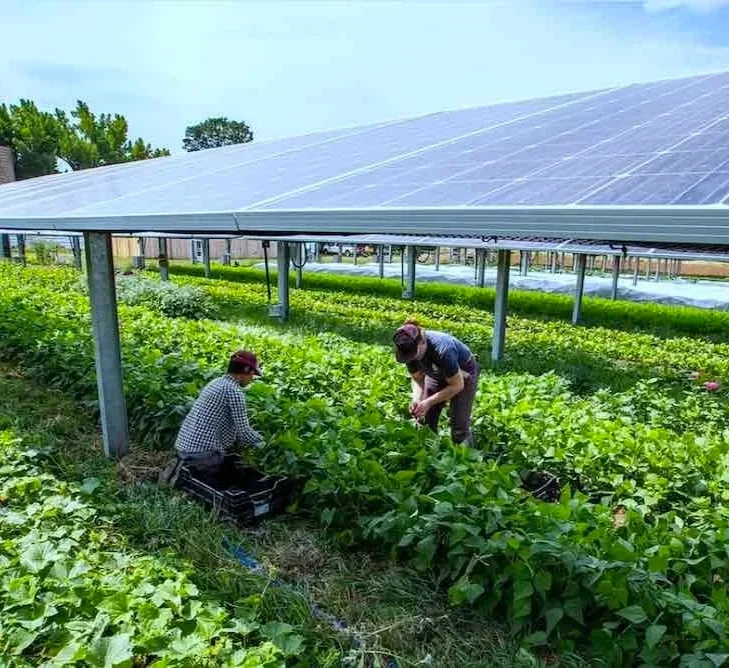
Agrivoltaics on a portion of the farm to help the sector commercialize.
Farmland conservation easements.
Shared farm infrastructure and equipment.
Irrigation and energy efficiency improvements.
Local food system grants to restaurants.
Support for 4-H, FFA, and conservation districts.
The Farmer Benefit Plan concept was originally developed by CURE in response to growing tensions between renewable energy development and agricultural communities. In 2024, USDA released a Farmer Benefit Plan guidance document as part of its recommendations for community benefit plans, which were required as part of the $40 billion investments in rural clean energy authorized by the Inflation Reduction Act. Common Acres Advisory guides stakeholders in the renewable energy and farmland sectors to assess options for designing and implementing this type of framework, which can include a set of land stewardship standards and farmer-governed Trust to invest in agricultural and community benefits.
The Common Acres Advisory Approach
Developers need flexibility, farmers want local control, and different communities will choose different priorities. To that end, Common Acres Advisory does not promote a single model.
Our role is to help clients evaluate options and understand tradeoffs. We provide strategic and quantitative analysis to compare alternative designs based on farmer impact, cost, administrative complexity, credibility, and scalability.
We help clients:
Design options rather than templates.
Quantify benefits and beneficiaries.
Compare costs and tradeoffs.
Develop credible local governance structures.
Adapt models for voluntary programs or public policy.
Identify approaches that can scale across counties, states, and federal programs.
The objective is not simply to solve individual siting disputes. It is to develop practical, evidence-based approaches that can deliver measurable benefits to farmers and rural communities at a scale large enough to matter.